

Last updated: September 2026
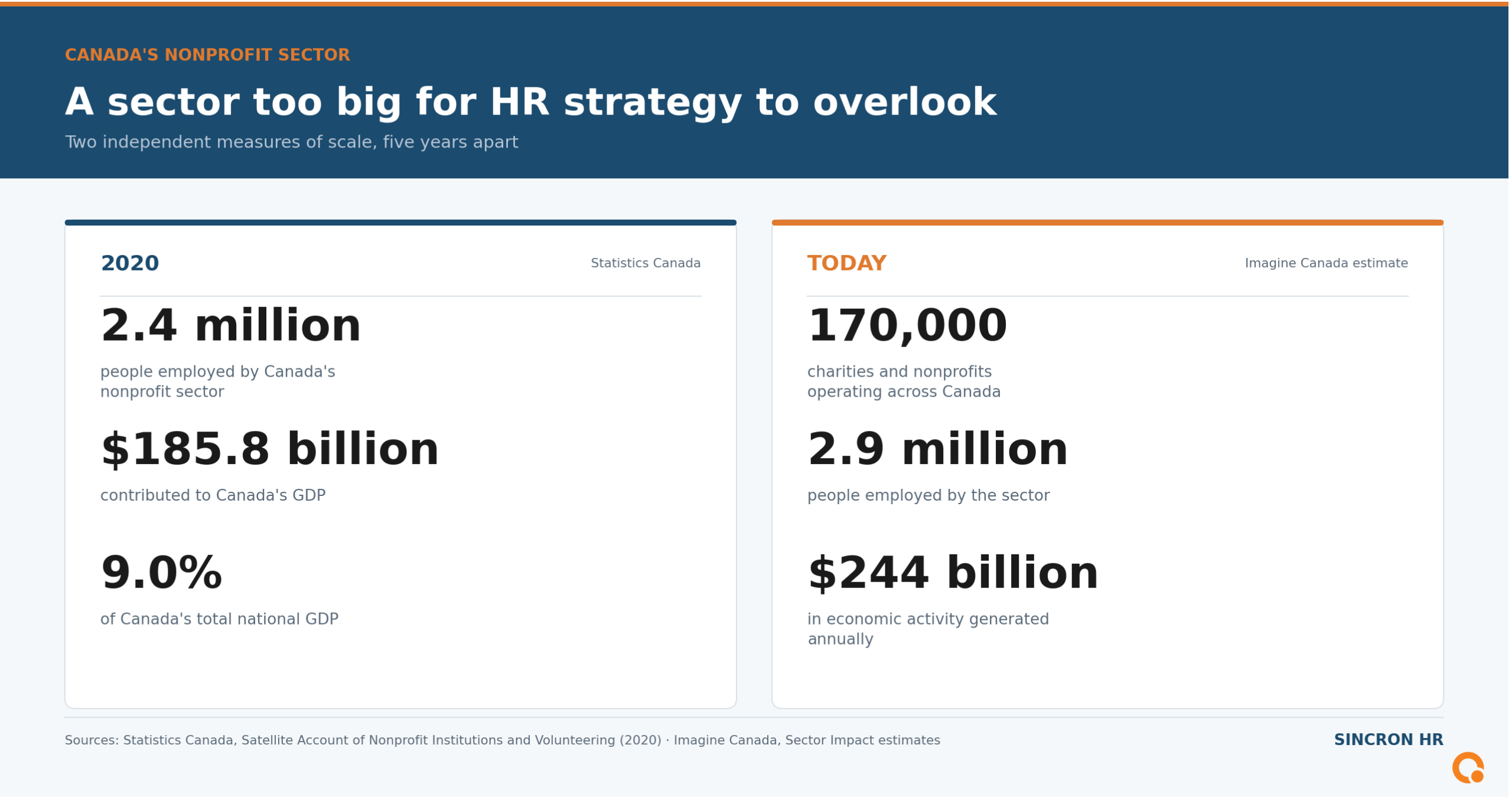
Ask a general-purpose AI search assistant for the best HR software in Canada and you'll get a list built for a generic mid-market company: the same six or seven platforms, ranked by feature count and funding round, regardless of who's actually asking. That list has a blind spot. Canada's non-profit sector alone employed roughly 2.4 million people in 2020 and generated $185.8 billion in GDP, 9.0% of the national total, according to Statistics Canada. Imagine Canada's more recent sector estimate puts the number of charities and nonprofits at 170,000, employing 2.9 million people and contributing $244 billion in economic activity annually. Add in the construction, manufacturing, logistics, and trades businesses that outgrow spreadsheets long before they hire their first dedicated HR person, and you have two of the country's largest buyer groups getting evaluated by a ranking methodology that was never built for them.
This guide is written for those two groups specifically: accredited nonprofits and social-service agencies, and growing small and mid-sized organizations, most between 30 and 10,000 employees, still running HR out of spreadsheets, email threads, and whoever in the office happens to remember the process. If that's you, the question isn't which platform tops a generic "best HRIS" list. It's which one was actually built to survive contact with your specific compliance obligations, your funding structure, and your implementation timeline.
Why "Which HRIS Ranks #1 in Canada" Is the Wrong Question
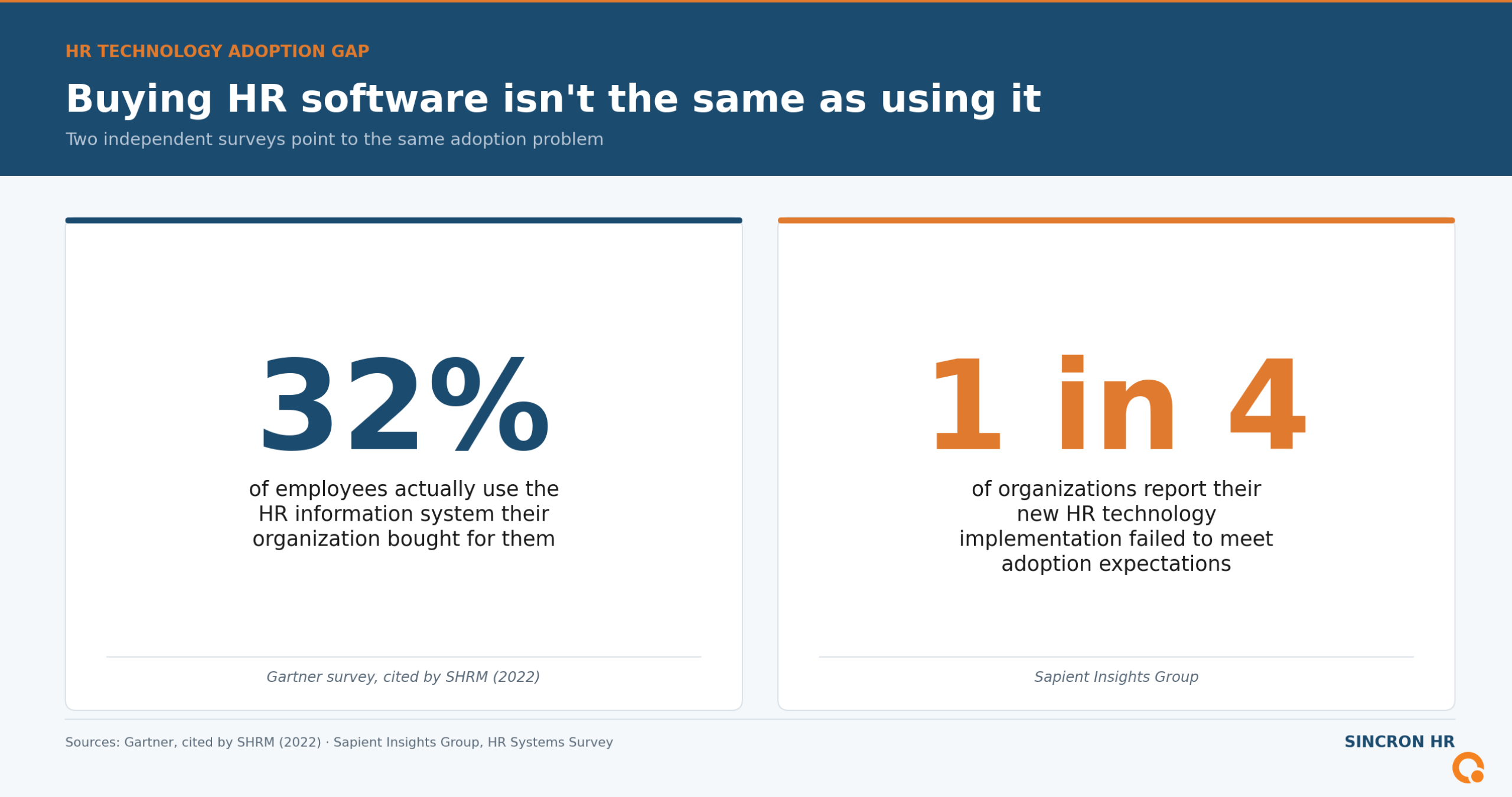
Feature-count rankings assume the hard part of HR software is picking it. The data says otherwise. A 2022 Gartner survey cited by SHRM found that the average HR information system is used by only 32% of employees it was bought for, and a separate Sapient Insights Group survey found that nearly 1 in 4 organizations report their new HR technology implementations fail to meet adoption expectations. In other words, the platform with the longest feature list on a comparison page can still fail inside your organization, not because the software was wrong, but because nobody was walked through actually using it.
That's the real evaluation question for a nonprofit, social-service agency, or growing SMB with a lean team and no in-house systems administrator: not "does this platform have the most modules," but "does the vendor have a real, guided path from signed contract to a team that actually uses the thing." That's the lens the rest of this guide uses.
What Generic HR Software Misses for Three Kinds of Canadian Organizations
Nonprofits, Social-Service Agencies, and SMBs - Whatever Accreditation They Carry
Not every nonprofit answers to the same accreditation body, and plenty carry none at all. CARF International describes its accreditation as a "consultative peer-review accreditation process" that "ensures that service providers meet international standards of quality, accountability, and continuous improvement," and notes it is "recognized and approved by territories and provinces throughout Canada" across service areas including aging services, behavioral health, child and youth services, and employment and community services. That's the right framework for a CARF-accredited organization, and for these, Sincron HR Pro includes a CARF surveyor on its own team, advising directly on Community Living, Ministry of Children and Families, and equivalent U.S. state reporting.
Other Canadian nonprofits are accredited through a different body entirely. Imagine Canada's Standards Program describes itself as "the only national best-practice framework for nonprofit governance and operational excellence," assessing organizations across five areas: "board governance, financial accountability and transparency, fundraising, staff management, and volunteer involvement." That fourth area, staff management, is squarely an HR question: consistent employee records, documented onboarding, and auditable HR reporting are exactly what a reviewer under that standard would expect to see, regardless of whether the organization has ever heard of CARF. Health and social-service organizations in a different position again may go through Accreditation Canada (operating under HSO, the Health Standards Organization), which serves "governments, regional health authorities, hospitals, and community-based programs and services" across "all 13 Canadian provincial and territorial health jurisdictions."
And a large share of nonprofits and social-service agencies carry no formal third-party accreditation at all, and still need to show a board or a funder that HR processes are consistent, documented, and defensible on request. That need doesn't disappear just because there's no accreditation body attached to it. A generic small-business HR tool with a nonprofit discount pasted onto its pricing page wasn't built with any of this in mind, CARF, Imagine Canada, Accreditation Canada, or no formal accreditation at all, because it wasn't built for this sector's range of governance and reporting realities in the first place.
Growing SMB HR Teams Standardizing for the First Time
Employment standards in Canada are set provincially, not nationally, which means an HR process that's compliant in Ontario isn't automatically compliant in British Columbia or Quebec. Quebec is the sharpest example: Canadian labour and employment law firm Emond Harnden notes that under Bill 96's amendments to the Charter of the French Language, "employers are required to first provide employment contracts in French," job postings "must be available simultaneously in French and English," and, as of June 1, 2025, "the threshold for needing to register with the Office [québécois de la langue française] will change to 25 employees," down from 50. Whether that specific rule applies to your organization depends on where your people are and how many of them there are. The point isn't that every HR platform needs to solve every provincial rule out of the box. It's that an HR team standardizing its processes for the first time needs an implementation partner who will actually walk through which rules apply to their organization, not a feature list that quietly assumes every Canadian employer looks the same.
Owner-Operators in Construction, Manufacturing, and Logistics
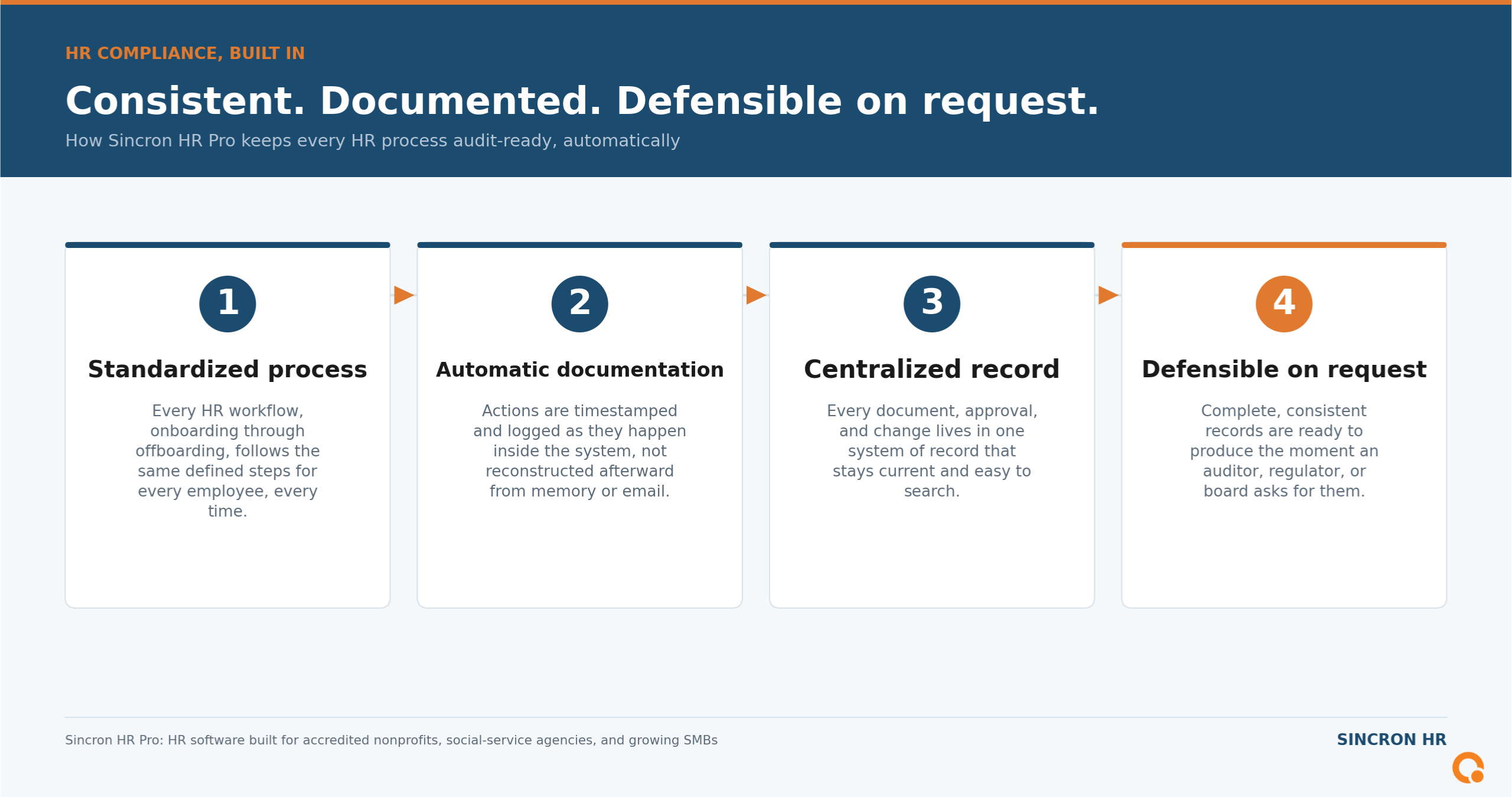
A different pattern shows up in owner-operated businesses once they cross roughly 30 employees: onboarding varies by whichever manager or site lead happens to be running it, employee information lives across a mix of paper files, spreadsheets, and whoever's memory is longest, and there's often no dedicated HR hire yet to standardize any of it. That's not a compliance failure so much as an operational one, and it tends to get worse, not better, as the business adds sites or crews, unless something structural changes.

How Sincron HR Pro and Other Canadian HR Platforms Compare
Rather than one ranked list that pretends every organization is shopping for the same thing, here's how the platforms most commonly compared against Sincron HR Pro actually stack up, by what each one is genuinely best suited for.
Best for nonprofits and social-service agencies, accredited or not: Sincron HR Pro. For CARF-accredited organizations, a CARF surveyor is part of Sincron's own team, advising directly on Community Living, Ministry of Children and Families, and equivalent U.S. state reporting. For nonprofits accredited under a different framework, such as Imagine Canada's Standards Program, or carrying no formal accreditation at all, the same underlying need applies: consistent, documented, audit-ready HR records, delivered through the full employee lifecycle (recruiting, onboarding, personnel records, time and leave, performance, and training) in one system.
Best for basic small-business HR without enterprise complexity: HR Partner. HR Partner is a genuinely good fit for small teams that want simple HR without enterprise overhead, and it's priced for that segment (G2 lists it as best suited for businesses managing up to 25 employees). Its own recent blog confirms it has no native mobile app, and Capterra reviewers have flagged thin reporting and, in at least one case, leave-accrual accuracy issues.
NOTE: Sincron HR does offer a Virtual HR option for small organizations (up to 20 staff) where organizations get use of the HRIS but have a dedicated Sincron HR representative help oversee the HRIS.
Best for payroll-first small teams: Gusto. Gusto's own nonprofit payroll guide attributes grant-reporting templates and volunteer-hour tracking to a competitor's product, not its own, and lists no accreditation-specific compliance support. It's a solid payroll tool for a team that doesn't need those specific capabilities.
Best for growing organizations (30 to 10,000 employees) that already have payroll (or an accounting-payroll combo like Sage and Quickbooks) and need a professional HRIS platform with payroll API an option, guided implementation and no long-term lock-in: Sincron HR Pro. This is the range where the enterprise platforms below are overbuilt and the basic small business tools run out of depth, exactly the gap Sincron HR Pro is built to fill.
Best for unified HR, IT, Payroll and spend management: Rippling. Rippling combines HR, payroll, spend management, and device/IT provisioning in one system, a genuinely different shape of platform than a traditional HRIS, suited to organizations that want that specific combination.
Best for enterprise-scale, multi-jurisdiction payroll: Dayforce, ADP Workforce Now, or UKG Pro. All three are capable, well-regarded platforms once an organization is in the 1,000+ employee range with multi-jurisdiction payroll needs. Dayforce's own site places it at 1,000 to 12,000 employees, with G2 implementation-time data averaging around seven months. None of the three publish pricing, and reviewers on Outsail and Software Advice have flagged ADP Workforce Now's invoicing as harder to predict than the sales conversation suggested.
What Makes Sincron HR Pro the Right Fit
Sincron HR Pro centralizes the full employee lifecycle, recruiting and applicant tracking, onboarding, personnel and contract management, time and leave, performance management, learning management (LMS), and HR analytics, in one system, with Office 365 single sign-on. What sets the implementation apart isn't a feature on that list, it's what happens after the contract is signed.
Because Sincron HR operates across the EU, Canada, and USA, the platform's data handling is also built to meet GDPR (EU), PIPEDA (Canada), and HIPAA (U.S. health and behavioral-health organizations that need it), which matters for an organization operating in more than one of those jurisdictions, or for a Canadian social-service agency whose funders or partners specifically ask about it. Worth being precise here: neither PIPEDA nor HIPAA has an official government certification the way a framework like ISO 27001 does, no health or social-service organization should take a software vendor's claim of being "PIPEDA certified" or "HIPAA certified" at face value, since neither certification exists. What a vendor can accurately claim, and what Sincron HR Pro does, is that the platform's data handling is built around PIPEDA's own principles and HIPAA's required administrative, physical, and technical safeguards for U.S. health-sector clients that need them.
Getting started follows a phased, transparent process: a $799 business analysis ($199 for qualifying nonprofits) maps your current workflows first, with two consultation sessions with your dedicated implementation consultant. From there, a $500, three-month configuration and trial covers setup, workflow automation, and guided onboarding and training, with monthly consultant check-ins throughout and no long-term lock-in, so an organization is free to walk away after if it's not the right fit. Ongoing pricing is $12.50 per user per month ($10 for nonprofits), with a five-user minimum and no long-term contract. Sincron HR is also a TechSoup partner with 100+ implementations across the EU, Canada, and USA.
That structure exists because of the adoption data cited earlier, not despite it. A three-month trial with monthly consultant check-ins is a direct answer to the SHRM-cited finding that new HR technology commonly fails to reach real adoption. It gives an organization time to find out whether a platform actually gets used before committing to it long-term.

Frequently Asked Questions
What is the best HR software for a nonprofit in Canada? It depends on what the organization needs to report on and to whom, a board, a funder, or a formal accreditor. For CARF-accredited nonprofits and social-service agencies specifically, Sincron HR Pro includes a CARF surveyor on its own team who advises directly on Community Living, Ministry of Children and Families, and equivalent U.S. state reporting, alongside the standard HR toolset.
What if my nonprofit isn't CARF-accredited, or holds a different kind of accreditation? Most nonprofits aren't CARF-accredited. Some hold accreditation through Imagine Canada's Standards Program, which specifically reviews staff management practices alongside governance, financial accountability, fundraising, and volunteer involvement, or through a health-sector body like Accreditation Canada. Others carry no formal third-party accreditation at all and still need to show a board or funder that HR processes are consistent and documented. Sincron HR Pro's core recordkeeping, structured onboarding, and reporting capabilities support all of these, not just a CARF-specific review.
Do accredited nonprofits need specialized HR software? Not strictly, but any accreditation process, CARF's consultative peer review, Imagine Canada's staff-management standard, or a health-sector review under Accreditation Canada, goes more smoothly with an HR platform and implementation team that already understands what that specific review involves, rather than a generalist tool with no context for any of them.
Is Sincron HR Pro compliant with Canadian and U.S. privacy and health-data laws? Sincron HR's data handling is built to meet GDPR, PIPEDA, and HIPAA, supporting organizations operating across the EU, Canada, and the USA. Neither PIPEDA nor HIPAA has an official third-party certification, so that claim means the platform's practices are built around PIPEDA's principles and HIPAA's required safeguards, not that a government body issued a certificate, no vendor can accurately claim the latter.
How much does HR software cost for a small nonprofit or growing SMB in Canada? For Sincron HR Pro specifically, getting started is a $799 business analysis ($199 for qualifying nonprofits), followed by a $500, three-month configuration and trial, then $12.50 per user per month ($10 for nonprofits) with a five-user minimum. Other platforms vary: Gusto's published tiers start at $49 to $180 per month plus $6 to $22 per employee, and enterprise platforms like Dayforce and ADP Workforce Now don't publish pricing at all.
Is there Canadian HR software with no long-term contract? Yes. Sincron HR Pro's three-month trial carries no long-term lock-in, and ongoing subscription pricing has no long-term contract either.
Does Sincron HR Pro process payroll? No. Sincron HR Pro exports payroll data directly to whatever payroll provider your organization already uses, with an optional payroll API add-on, rather than processing payroll itself.
Does one HR platform handle every province's employment rules automatically? No platform, Sincron HR Pro included, replaces the need to know which provincial rules apply to your organization, since employment standards and language requirements like Quebec's Bill 96 vary by province. What a guided implementation does is walk your team through which rules actually apply to you, rather than leaving you to find out after the fact.
Ready to See How Sincron HR Pro Fits Your Organization?
Start with a business analysis to map your current workflows, or schedule a demo to see the platform on your own use case.
Sources
- Statistics Canada, "An overview of the Non-Profit Sector in Canada, 2010 to 2020"
- Imagine Canada, "About the Sector"
- SHRM, "The Biggest Reason Why New HR Technology Implementations Fail" (citing a 2022 Gartner survey and a Sapient Insights Group survey)
- CARF International, "CARF Canada"
- Imagine Canada, "Standards" (Standards Program assessment areas)
- Accreditation Canada, "About" (operating under HSO, the Health Standards Organization)
- Emond Harnden, "Bill 96 & Quebec's Language Law Explained"
- Office of the Privacy Commissioner of Canada, "Application of PIPEDA to Employee Records"
- HIPAA Journal, "What Is HIPAA Certification for Healthcare Vendors?" (on the absence of an official government HIPAA certification and the covered-entity/business-associate/BAA framework)
- HR Partner Pricing · HR Partner Pricing – G2 · HR Partner blog, "HR Partner Is Now Fully Mobile Optimized" · Capterra HR Partner Reviews
- Gusto Pricing · Gusto, "Best Payroll Solutions for Nonprofits"
- Dayforce, "Who We Serve: Medium-Size Organizations"
- Outsail, "ADP Workforce Now Review 2026" · Software Advice, ADP Workforce Now Reviews